AZ-802 Practice Test Engine & AZ-802 Certification Sample Questions
The price of Microsoft AZ-802 updated exam dumps is affordable. You can try the free demo version of any Microsoft AZ-802 exam dumps format before buying. For your satisfaction, DumpStillValid gives you a free demo download facility. You can test the features and then place an order. So, these real and updated Administering Windows Server AZ-802 Dumps are essential to pass the AZ-802 exam.
Microsoft AZ-802 Exam Syllabus Topics:
| Section | Objectives |
|---|---|
| Disaster recovery and migration | - Migration scenarios
|
| Monitoring and troubleshooting | - Diagnostics
|
| Manage hybrid compute and virtualization | - Containers
|
| Networking and storage infrastructure | - Networking
|
| Implement and manage high availability | - Failover clustering
|
| Secure Windows Server hybrid infrastructures | - Identity and access management
|
>> AZ-802 Practice Test Engine <<
100% Pass-Rate Microsoft AZ-802 Practice Test Engine and Pass-Sure AZ-802 Certification Sample Questions
Many people are afraid of walking out of their comfortable zones. So it is difficult for them to try new things. But you will never grow up if you reject new attempt. Now, our AZ-802 study quiz can help you have a positive change. It is important for you to keep a positive mind. Our AZ-802 Practice Guide can become your new attempt. And our AZ-802 exam braindumps will bring out the most effective rewards to you as long as you study with them.
Microsoft Administering Windows Server Sample Questions (Q414-Q419):
NEW QUESTION # 414
Your network contains an on-premises Active Directory Domain Services (AD DS) domain. The domain contains a user named User1 and the servers shown in the following table: Server1 (Windows Server 2016), Server2 (Windows Server 2022), Backup1 (Windows Server 2019). User1 is a member of the Protected Users security group. User1 performs the following actions: * From Server1, establishes a remote PowerShell session on Server2 * From the PowerShell session on Server2, attempts to access a resource on Backup1 The request to access the resource on Backup1 is denied. You need to ensure that User1 can access the resources on Backup1 by using the PowerShell session on Server2. The solution must follow the principle of least privilege and minimize administrative effort. What should you configure?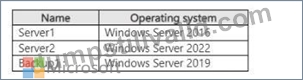
Server OS version table
- A. PSSessionConfiguration by using RunAs
- B. Kerberos delegation (unconstrained)
- C. resource-based Kerberos constrained delegation
- D. CredSSP
Answer: A
Explanation:
This is a classic Kerberos double-hop scenario, but with a critical twist: User1 is a member of the Protected Users security group, and Microsoft ' s documentation on the Protected Users group explicitly states that members are unable to " delegate with unconstrained or constrained delegation, " and separately that Credential Delegation (CredSSP) " doesn ' t cache the user ' s plain text credentials even when the user enables the Allow delegating default credentials Group Policy setting. " This means neither unconstrained Kerberos delegation nor CredSSP can be used to solve the double-hop for User1 ' s own credentials -- both are explicitly blocked by Protected Users membership by design, and resource-based constrained delegation relies on the same underlying Kerberos S4U ticket-delegation mechanism for the user ' s identity, which Protected Users membership likewise prevents from being used. The solution that sidesteps the problem entirely, rather than attempting to delegate User1 ' s own (undelegatable) credentials, is to configure a PowerShell session configuration (as used in Just Enough Administration) on Server2 with a fixed RunAs credential: commands run inside that session configuration execute using the RunAs account ' s identity when reaching out to Backup1, rather than using User1 ' s identity for the second hop at all, so no delegation of User1 ' s own protected credentials is ever needed. This also satisfies least privilege and minimal administrative effort, since a single, purpose-built session configuration can be scoped to exactly the actions User1 needs, without provisioning any delegation for User1 individually. Therefore, configuring a PSSessionConfiguration that uses RunAs is the correct solution.
NEW QUESTION # 415
You have an Azure subscription that contains the storage accounts shown in the following table. In the West US Azure region, you create a storage sync service named SyncA. You plan to create a sync group named GroupA. What is the maximum number of cloud endpoints you can use with GroupA?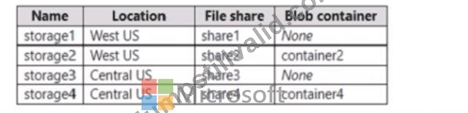
Storage accounts table
- A. 0
- B. 1
- C. 2
- D. 3
Answer: C
Explanation:
In Azure File Sync, a sync group defines the synchronization topology between exactly one cloud endpoint (an Azure file share) and one or more server endpoints (on-premises or IaaS VM paths). Microsoft ' s documented Azure File Sync limits state explicitly that a sync group can contain, at most, a single cloud endpoint -- there is no supported configuration in which a sync group is associated with two or more Azure file shares simultaneously. This 1:1 relationship between a sync group and its cloud endpoint is a hard architectural limit, not a configurable quota, and it holds true regardless of how many storage accounts exist in the subscription or which Azure region the Storage Sync Service (SyncA) was created in. The number of available storage accounts shown in the exhibit ' s table, and the fact that they might reside in the same or different regions, does not change this per-sync-group limit; each additional cloud endpoint would require creating an entirely separate sync group rather than adding it to GroupA. By contrast, a sync group can contain multiple server endpoints, registering as many on-premises servers/shares as needed to sync against that single cloud endpoint. Therefore, the maximum number of cloud endpoints that can be used with GroupA is 1.
NEW QUESTION # 416
You have a three-node failover cluster. You need to run pre-scripts and post-scripts when Cluster-Aware Updating (CAU) runs. The solution must minimize administrative effort. What should you use?
- A. Run profiles
- B. Windows Server Update Services (WSUS)
- C. Azure Functions
- D. Scheduled tasks
Answer: A
Explanation:
Cluster-Aware Updating supports the -PreUpdateScript and -PostUpdateScript parameters on Invoke-CauRun, and these settings, along with every other CAU configuration option such as the maximum retries per node and the update categories to apply, can be saved together into a single reusable updating run profile, which is stored as an XML file. Once a run profile has been created and is referenced using the -CauPluginArguments or -RunProfile parameter on a subsequent CAU run, or configured as the default profile for self-updating mode, every future CAU run automatically applies the same pre- and post-update scripts without the administrator needing to re-specify them each time, which is precisely what minimizing administrative effort for this recurring maintenance task looks like. Scheduled tasks have no built-in awareness of cluster node draining, pausing, or update orchestration and would require substantial custom scripting to coordinate safely, WSUS only manages which updates are approved for distribution and has no scripting hook into CAU ' s node lifecycle at all, and Azure Functions is a cloud compute service entirely unrelated to on-premises CAU orchestration. Therefore, run profiles are the correct answer.
NEW QUESTION # 417
You create an Azure virtual machine named Server1 that runs Windows Server.
Server1 has the disk configuration shown in the following exhibit.
You need to create a new 100-GB volume on Server1.
Which three actions should you perform in sequence? To answer, move the appropriate actions from the list of actions to the answer area and arrange them in the correct order.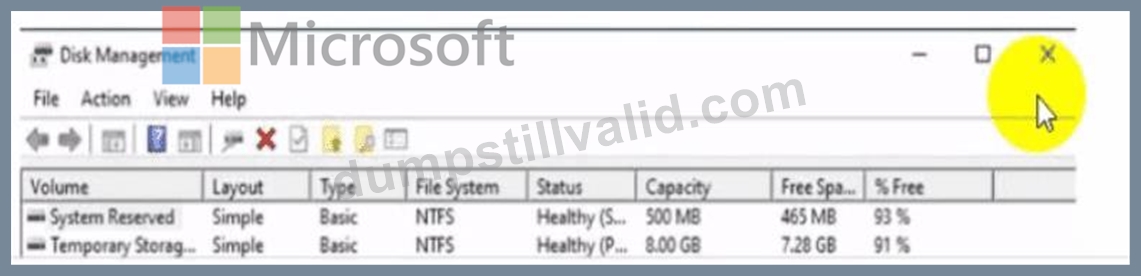
Server1 ' s current Disk Management view: only System Reserved and Temporary Storage volumes exist; no data disk yet.
Answer:
Explanation:
Explanation:
1. Create and attach a new data disk. 2. Initialize the disk. 3. Create a new simple volume.
Azure supports attaching a new managed data disk to a running virtual machine as an online operation, so the process begins in the Azure portal (or via CLI/PowerShell) by creating and attaching a new data disk to Server1 without needing to shut the VM down first, since data disk attach/detach does not require a stop/start cycle the way a size change does. Once the disk is attached, it appears to the guest operating system as raw, uninitialized storage, so inside Windows Disk Management (or diskpart) the next step is to initialize the disk, which writes a partition table (GPT is the modern default) and brings the disk online so Windows can create partitions on it. The final step is to create a new simple volume on the initialized disk, which allocates the partition, assigns a drive letter, and formats it with a file system, making the storage usable. Shutting down and starting Server1 are unnecessary distractors, since attaching a data disk to an Azure VM does not require downtime. Creating a spanned volume is also inapplicable here, since a spanned volume is a legacy dynamic- disk construct used to combine multiple disks into one logical volume, which is not needed when provisioning a single new data disk; a simple volume is the correct, minimal construct for this task.
NEW QUESTION # 418
Your network contains an Active Directory Domain Services (AD DS) domain named contoso.com. The domain contains a DNS server named Server1. Server1 hosts a DNS zone named fabrikam.com that was signed by DNSSEC. You need to ensure that all the member servers in the domain perform DNSSEC validation for the fabrikam.com namespace. What should you do?
- A. From a Group Policy Object (GPO), add a rule to the Name Resolution Policy Table (NRPT).
- B. From a Group Policy Object (GPO), modify the Network List Manager policies.
- C. On each member server, run the Add-DnsServerTrustAnchor cmdlet.
- D. On Server1, run the Add-DnsServerTrustAnchor cmdlet.
Answer: A
Explanation:
DNSSEC validation can happen at two different layers: on a DNS server that is itself resolving/forwarding queries on behalf of clients, or directly on a Windows client/member server acting as its own DNS resolver.
Add-DnsServerTrustAnchor configures a DNS server role to trust and validate a signed zone hosted elsewhere; it is a server-side setting that applies to whichever machine runs the cmdlet, and running it on every member server would require the DNSSEC-Server feature/role and repeated per-machine configuration, which does not match how member servers normally resolve names (they are typically DNS clients, not authoritative or validating DNS servers themselves). The mechanism built specifically for Windows client- side DNSSEC validation is the Name Resolution Policy Table (NRPT), which is distributed centrally through Group Policy: an NRPT rule can be scoped to a specific namespace, such as fabrikam.com, and configured to require DNSSEC validation for any query the client ' s DNS Client service resolves for names in that namespace, rejecting responses that fail validation. Because the requirement is for all member servers domain- wide to perform this validation, and Group Policy is the standard way to apply a setting to many machines centrally and consistently, adding an NRPT rule via GPO is the correct approach; it also avoids the per- machine cmdlet execution that Add-DnsServerTrustAnchor would require. Network List Manager policies control how machines classify and respond to different network location types (domain, private, public) and have no relationship to DNSSEC at all.
NEW QUESTION # 419
......
In this circumstance, if you are the person who is willing to get AZ-802 exam prep, our products would be the perfect choice for you. Here are some advantages of our AZ-802 exam prep, our study materials guarantee the high-efficient preparing time for you to make progress is mainly attributed to our marvelous organization of the content and layout which can make our customers well-focused and targeted during the learning process. As a result, our AZ-802 Study Materials raise in response to the proper time and conditions while an increasing number of people are desperate to achieve success and become the elite.
AZ-802 Certification Sample Questions: https://www.dumpstillvalid.com/AZ-802-prep4sure-review.html